With this kind of story, it allows the story of Arthur to take on new life and evolve in a way that wouldn't be possible with a simple regurgitation of the legend. Through a teenage girl discovering the similarities of her high school crush to the great King Arthur, the story has now evolved into a modern tale that uses the original as a stepping stone. Without competing with the legend, stories like this one play with the idea of expanding. By taking the impressions left by the legend and creating something new, Cabot is taking the potential of expanding the legend and allowing it to flourish for a new audience. In this way, Arthur is no longer a hero, because he is not simply being remembered. He is a legend because he can't die with the, in this case literal, rebirth.
Showing posts with label Victoria Callahan. Show all posts
Wednesday, April 25, 2018
Heroes Get Remembered, but Legends Never Die
By this definition, King Arthur is a legend. Texts like Avalon High prove that though King Arthur stands on his own, the way authors and storytellers continue to adapt the story perpetuate the tale in new ways. Mr. Morton/The Order of the Bear/Professors Harrison help demonstrate this point; Meg Cabot chose not to simply tell the story of King Arthur, but transform it into a Christ-like tale of resurrection, using Will as the hero of the world to save humanity the way Arthur did. With a sprinkle of cheesy teenage love.
Wednesday, April 11, 2018
Mists of Avalon
I don't believe this passage is necessarily a feminist approach to this story. The emphasis on masculinity and the need for a God to match her Goddess (she really says this) is inescapable. Lancelot proves himself to be the man's man when he says a few times that he "has lived in a world where men do not wait for a woman's bidding" (146). Morgaine exerts a lot of energy admiring Lancelot's physical appearance, and is heavily influenced by the way she feels when she's near him. Starting at their first interaction, her obsession with his outward appearance is perpetuated throughout the passage; on page 147 she spends almost an the page admiring every detail of his physique. She likes that his look is not androgynous, but especially manly like a "stag," and comments that she had "never seen such a masculine creature before" (147). This fixation on his appearance is especially annoying compared to Morgaine's own desire for Lancelot to see her inner beauty when she apparently sees only his surface level.
The physical attraction is noteworthy, but what really makes me doubt the woman-power in this passage is the fact that Morgaine says she has never felt happiness before Lancelot. She feels validated because “he desired her...his love and respect for her were so great that he would even hold his own desire within bounds” (154). So now we’re impressed that he's not pushing sex on her? Cmon. And let’s just take a moment to consider the phallic implications of Lancelot saying the only god he worships is his “sword” (140). Lancelot seems to quickly shift gears, and Morgaine feels a burning hatred for young Gwenhwyfar, concluding with what I think might be a redeeming moment (maybe just a petty one) as Morgaine leaves him to find his own way back.
Wednesday, March 28, 2018
The Lady of Shalott
Tennyson tells a tragic tale of disappointment in The Lady of Shalott. This near-mythical woman is cursed to a very minimalist, monotonous life, but "she knows not what the curse may be" (42) should she leave. Tennyson shows through the poem that the Lady is waiting for true love, evidenced when he mentions that she "hath no loyal knight and true" (62), and again when she sees the newlywed lovers and proclaims "'I am half sick of shadows'" (71). So, did Lancelot inspire her to leave the island (and potentially ruin/lose her life), or was she just waiting for someone to give her that nudge? Lancelot says in Malory's text "God knows that I did not intentionally lead her to this....alas! she loved too much" (471), but I'm not sure if the same can be said for the Lady in Tennyson's poem.
Monday, March 5, 2018
The "Ask Arthur" Column
In this week's column, the noble King Arthur will answer your burning questions! All anonymous all the time.
Dear Arthur,Dear Forlorn,
My son was conceived out of wedlock with another man's wife before I married her after he died. A series of tricks and magic got me into her bedroom...I mean sure she thought I was her then-husband, but that's neither here nor there. Keep in mind that this was not my fault: my health was in danger! Should I tell my son about this weird conception? I can't say much more because I don't wantyouhim to figure out who's writing.
-Forlorn Father
I'd say don't tell
-King Arthur
Dear Mournful,Dear Arthur,
I'm extremely wise and magical - I'm, like, really smart. I became the wisest guy in all the land on my first try! Please blindly believe what I'm saying: I'm not crazy. Never been to a psychiatrist. I even had a good (great) meeting at the round table today! The mainstream media tries to discredit me, but trust me. Also I'm not hairy and never have been hairy. Now to my question...I've got a nubile, beautiful huntress lady friend, but I'm like *pretty* sure she hates me. All-knowing stuff aside, I can't see how exactly I'll die, but something tells me not to trust this pretty young thing. I give and I give and she just doesn't seem into me for some reason. She swats my hand away whenever I try to hold it. What should I do? I might die...but I really want to deflower her.
-Mournful Magician
We've all been there. Your question is valid. My advice is to trust your instincts! If you think this beautiful lady is too good to be true and you're as all-knowing as you say you are (and I'm inclined to believe you based on those credentials), run for the hills! Unless you think the sex is super worth it, in which case, what do you really have to lose?
-King Arthur
Arthur,
I've always been a little different from my peers. I'm guessing it's due to my skin (I'm green lol), or because of my tendency to go to parties asking for my head to be lobbed off. Here's the thing: I had my wife try to trick this guy, whose head I was about to chop, into sleeping with her, and he was supposed to say no (long story, don't ask, but this was the deciding factor on his head staying where heads belong). But he kissed her a few too many times if you ask me. Didn't sleep with her! Toed the line, was pretty cautious. Should I spare him? Did he find the loophole?
-Not-so-jolly Green Giant
Dear Not-so-jolly,
I say let him live. Sounds like this guy was noble in the face of temptation. Maybe this could lead to a life-long friendship where the two of you chop heads and get chopped together? Sorry about the kissing though...maybe try a different plot next time.
-King Arthur
That's all we've got for this week! Don't forget to write questions to your King for some royally insightful answers!
Wednesday, February 28, 2018
Gawain the Good Guy
Gawain is faced with a woman who is throwing herself at him, but he remains "gracious--and also on his guard" (443). Clearly, Gawain is a good guy as he consistently toes the line between gracious and cautious. As the Green Knight confesses his plan, Gawain says on page 472:
"But it's no great wonder whenever a woman outwits
A man and leads him away to mourning or to madness,
For Adam himself was led astray by a woman" (2414-2416).
He lists other men who were misled by women, but why are women to blame in this case if the Green Knight literally just admitted that it was his own plan? I might be missing something, but it seems like Gawain is unfairly blaming the ladies for executing a plan that was conceived by a man.
Tuesday, January 30, 2018
Arthur is The Man
The common thread throughout Geoffrey of Monmouth's history of Arthur is that he is the capstone of kings: slaying giants, slicing heads in half, or just being a generous, religious monarch. Arthur is the best and brightest, and seems to think of himself as such. This song by The Killers seems to convey exactly what Geoffrey of Monmouth is trying to (if we take the lyrics as lyrics and ignore any social commentary). Arthur's carrying the crown, and nothing can bring him down.
Tuesday, January 23, 2018
Speaking Something into Existence...on a Royal Level
"'Britain has kings,' writes Gildas, 'but they are tyrants'" quotes Snyder on page 70, in the second document (chapter four).
Stemming from this quote, I wonder whether this desire for better kings prompted the myth of an idealistic king from a "famous, devout military hero" (73), although he was "not himself a king" (77). The figure of a pious, successful knight would serve as a wonderful king, and even if he wasn't a king in actuality, that person seems to be the perfect fit for a legend. Given enough momentum and will power, I think it makes a lot of sense that King Arthur would just sort of...be created. I think it could also be propelled by, if I'm reading this correctly, the Tudors looking to tell people they were descended from the great King Arthur, and validating his existence even more.
Sunday, January 21, 2018
Guinevere is a Feminist Icon!
While I know very little about historical accuracy, this movie seemed to check the important boxes. The knights, the armor, the weaponry, transportation methods, etc, all seemed to match my idea of what they "should be." This movie begins by suggesting to the viewer that King Arthur was a real guy during the Dark Ages, which may have colored the way I viewed it; that being said, I was willing to believe that this small, scrappy crew would've been successful behind the wise Arthur and his humanitarian ways. At least, I believe it could've been based on a real person and group.
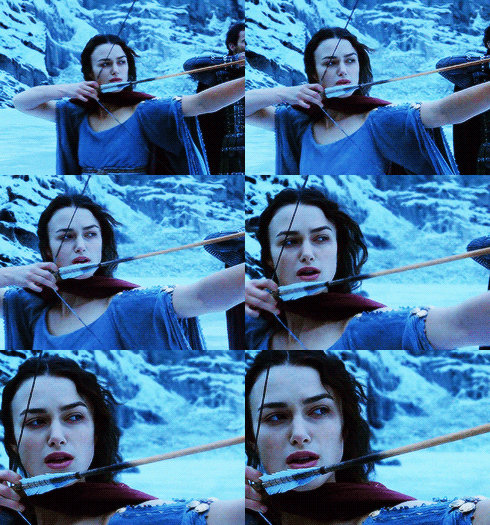
A surprising factor of this movie was the agency given to Guinevere. Keira Knightley does a great job at playing the damsel-not-in-distress as she calls Arthur on his bullshit (see: "animals live, don't you want to live free") and holds her own...once she's rescued from prison. She chooses to stand on the sketchy frozen body of water and fight with the group of round-table knights. Guinevere also chooses to sleep with Arthur rather than the other way around; the way it is shot shows that she is in control of the situation, as she makes the sexual advances and seduces Arthur.
I question the accuracy of a prisoner not only being able to freely speak her mind to a knight, but to also go on to marry a king. I wonder, too, about the legitimacy of a woman choosing to fight in a battle with absolutely no contest. I'm sure that women had more agency than what I was taught to believe, but something tells me that may be a bit exaggerated for the purposes of telling the story...I don't know, maybe I'm overthinking but it just doesn't click for me. All that said, I love seeing a powerful woman in full control of what she does in the battlefield and in the bedroom. You go Guinevere!
![]() |
| she looks super badass tho |
Subscribe to:
Posts (Atom)