The
Lady of the Shalott has themes of tragedy, grief and loss.
Tennyson creates a mood of mystery and confusion throughout the poem. The
ending was the acknowledgement that the death was tragic and harsh when
Lancelot says “’she has a lovely face; God in his mercy lend her grace.’”
(Tennyson 169-170) Such a statement makes the Lady more of a tragic figure;
Lancelot had no idea that he had caused such a lonely and painful death. The
river serves as the main symbol in the poem. It seems as though Camelot pulls the
Lady towards her death, and the river reflects this pull. The river is calm,
but it is used to show the danger that looking toward Camelot means. The river
reflects the lady’s thoughts and actions. When the Lady of Shalott starts to
have pain from not being able to look herself the river responds by creating
small whirlpools. (Tennyson 51) The river keeps coming back to the text to show
a transition from peace to tragedy. Upon
realizing that she has cursed herself by looking at the real world with her own
eyes, there is a “dim expanse.” (Tennyson 127) By looking towards Camelot and
Lancelot, she cursed herself to death and the river personifies this; the river
reflects the Lady. The river was put in the poem as an image to reflect the
plot moving along.
Showing posts with label The Lady of Shalott. Show all posts
Wednesday, March 28, 2018
The Dullness of Shalott
Parts I and II of Tennyson's "The Lady of Shalott" highlights the contrast between the island of Shalott and the surrounding lands. The reader learns that "Four gray walls, and four gray towers, / Overlook a space of flowers, / And the silent isle imbowers / The lady of Shalott" (15-18). Tennyson reveals little else about Shalott itself, though that the Lady of Shalott has "little other care" than her weaving (44) implies that there is little else to say about Shalott. It is a dull and featureless island that most people pass right by without noticing; only the nearby reapers ever remark on "the fairy / Lady of Shalott" (35-36).
The second and third stanzas of Part II list people who pass by Shalott while going to and from Camelot. For example, "Sometimes a troop of damsels glad, / An abbot on an ambling pad, / Sometimes a curly shepherd-lad, / Or long-hair'd page in crimson clad" each go by within a single line of verse (55-58). The quickness with which Tennyson presents these people conveys the fullness of activity not far from the island. The highway to Camelot is energetic, noisy, bustling, and exciting. However, all that our poor Lady gets to see of this is shadows in her mirror. Looking at the liveliness right outside her window is too big a risk. She must remain in the dullness of Shalott.
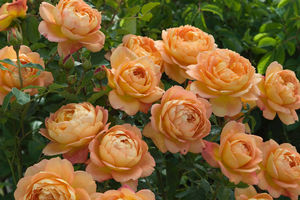
Did you know that there is a Lady of Shalott flower?
Four Walls, Four Towers, and Some Boats
Part one of “The Lady of Shallot” provides beautiful imagery and thought-provoking
symbols. Nature plays a significant role in the poem because weather, plants,
and the river connect The Lady of Shalott to the outside world. The lilies
around the tower on the island are in contrast to the fields of barely leading
to Camelot. The lilies are beautiful while the fields of barley are monochrome.
The beauty of the Lilies represents the beauty of The Lady of Shalott. Also, on
the island Lord Tennyson describes four grey walls and four grey towers which
seems strange. The four grey walls could represent the strength of the person
or creature that is holding The Lady of the Shalott captive in the tower. Also,
the walls may represent the isolation and powerlessness of women during the
time that the poem was written. During this time women had little control over
their lives and were treated as property. The four towers could represent the
four evangelists Matthew, Mark, Luke, and John who connect The Lady of Shalott
to God. The Lady of Shalott might be too pure to live among sinners which is
why she is isolated. Furthermore, the
boats on the river play a key role in the poem. The boats may represent the
ultimate freedom that The Lady of Shalott will have in heaven and the life that
has been passing her by. Finally, the
reapers are the only people who have heard The Lady of Shalott sing because of
their connection to nature. The reapers plant the barely, tend to the plants,
and harvest it which gives them an understanding of nature. Overall, part one
of the poem is written in a way that makes it sound magical and light-hearted
which is in contrast to the other three parts of the poem.
Tuesday, March 27, 2018
So... not the five stages of grief...
I feet that this is a great representation of how Launcelot treated Elaine when she said she would die without his love, as well as everyone else when she did die. The exact opposite of how everyone acted when Launcelot was wounded.
Subscribe to:
Posts (Atom)