Showing posts with label Once & Future King. Show all posts

Monday, April 9, 2018

Treason and Reason

"I have tried to do my duty."
"Ye have striven to admiration."
"I sentenced her because it was the law to sentence her. I have done my best to see the sentence will be carried out."
"But it willna be. Lancelot will bring her safe."
"Gawaine, you are not to think that I am trying to get her rescued. I am the justice of England, and it is our business now to burn her to the death, without remorse."

Gawaine's first line really hits it on the head here, whether Arthur is willing to admit it or not. We see Arthur's admiration cloud his judgement multiple times throughout the passage. It's accepted that he knows about the affair, but keeps it hushed for the greater good of the kingdom. That's why he isn't surprised when the brothers and Mordred bring it up to him. Many before him have brought it to his attention, all to be killed by Lancelot in combat. I also love that killing your opponent holds legal weight, and the victor is the one considered to be just and right. It's like if Evander Holyfield led OJ's defense team. It almost seems to me that Arthur is accepting of the affair because of the great deal of love that he has for Guinevere and Lancelot. That's why he opposes trapping them. Because of the love and respect he has for them, he can't, in good conscience, do what he thinks will be deceiving them, even though they've been doing that to him for years. This is also weird logic coming from a man who put an entire boat full of babies to death just to save himself from the wrath of his son.

Revolution of not fighting


"They were always saying that the resent [war] was to be the last, and afterwards there was to be a heaven."pp. 631-632

The narrator is talking about how every war is supposed to be the last war. Merlyn has been trying to get Arthur to see that war is not right, which Arthur tries to fix. He wants to change the reasons for war. Arthur's own kind of revolution.

Wednesday, April 4, 2018

Arthur the Forever Flawed


In all the stories we've read so far, the Arthur moment that has bothered me the most was killing the babies on the ship in our Malory text. It didn't make sense to me, and it felt so out of character with the King Arthur I thought I knew before starting this class. This is why I love the scene in this book where he tells Lancelot and Guenever about what he did. I'm really glad T.H. White kept this detail, because I think it's important. Lance and Gwen try to justify Arthur's actions by saying, "Hey, Mordred's alive though! No harm, no foul!" But Arthur says, "You mustn't forget the other babies...I dream about them" (549). Arthur is still haunted by the actions he took in his past, and he faces them head on. He doesn't try to explain them away now that he is an older man, and he doesn't blame Mordred at all for wanting to kill him. Depressing? Yes. But this Arthur feels so much more human. He knows he has flaws, and he spends much of our last chapter trying to better himself and his kingdom. This Arthur isn't perfect, and I think he's better off for it.

First Impressions

What does our first impression of Merlyn tell us about his character in this story? And why is it so different than other tales of/ with Merlin?


Merlyn the Timelord and Arthur his Companion


"There is a thing about Time and Space
which the philosopher Einstein is going to find out.
Some people call it Destiny." Pg.286
I believe no other story we have read thus far has gone as in depth into the friendship and teachings of Merlyn and Arthur. Even when Arthur has become king he still looks to Merlyn for guidance, especially on page 247 when Arthur believes he knows why Might isn’t Right and how Might can be Right. In this scene I believe Arthur to going back to being a child and looking up to his tutor/teacher for guidance hoping he has the right answer. Merlyn not responding to this moment shows that he no longer wants Arthur to look for him for anything else because he won’t always be there, he only praises Arthur when he starts thinking for himself and doesn’t rely on Merlyn anymore. But I believe the real reason why Merlyn doesn’t look at Arthur during his speech is because Merlyn doesn’t actually know whether his teachings are right or not. He goes in time backwards but knows that any decision he makes can affect the future which he has already lived, which is why he keeps telling Arthur what happens just in case things don’t work out completely the way it’s supposed to. Merlyn knows any sort of mistake he make affects the future, he has to make sure the lessons he teaches Arthur are the right ones. Arthur’s big speech is the result of everything Merlyn has taught him and it seems like the beginning of Arthur’s legacy. It’s like The Doctor from Doctor Who letting go of his companions in the hopes that they will be better off without him and they will do greater things because they knew him.


Virtue of Knowledge and Freedom

            Image result for king arthur and excalibur

It is in my opinion that today’s reading underlined some of the main virtues King Arthur must embody or learn in order to be a great and successful leader. Throughout the different texts, Merlyn is guiding and teaching Arthur in various ways. But, Merlyn cares only to impart a certain kind of wisdom to Arthur.  Merlyn doesn’t think that just because one can fight or joust well that that person is educated or wise. I think that Merlyn wants Arthur to actually learn morality, individuality and freedom. At first Arthurs thoughts and actions are childish. I think that Merlyn changed Arthur into a fish to show him that life wouldn’t be very much different if he were actually a fish. I think this encourages young Arthur to be more comfortable with who he is or more accepting of life in general. Then Merlyn showed Arthur his favorite knight King Pellinore. Arthur seemingly idolized his knighthood skills and I think Merlyn was attempting to show him that just because someone is a great knight does not mean that they are a great person. King Pellinore cheated during the fight which seems counter intuitive to a pure character. Then as the reading continued Arthur learned that Might isn’t Right and that things should be done because it is right for it to be done. At one point Merlyn gets annoyed by Arthur for asking him a question and emphasized the importance of being able to think all on your own. In order for Arthur to quell rebellion and to achieve peace, he must defeat ignorance in thought and ignorance in the old ways of life. Once Arthur matures more in wisdom he is able to turn the tides of the rebellion to end the fight. I think this is also an allegory for the rebellion that takes place within our own minds. Think about the times you wish things were different for yourself, or how our actions stemming from ignorant thoughts have caused injury to ourselves or to others. Think about the  fight between good and evil in ourselves. Merlyn wants peace, wisdom and virtue to reign. This is something he wants to instill in Arthur so that Arthur could then instill in his kingdom. Wisdom frees us from ignorance and grants us individual freedom. Ignorance enslaves our minds and actions. 

Sunday, January 21, 2018

Guinevere is a Feminist Icon!

While I know very little about historical accuracy, this movie seemed to check the important boxes. The knights, the armor, the weaponry, transportation methods, etc, all seemed to match my idea of what they "should be." This movie begins by suggesting to the viewer that King Arthur was a real guy during the Dark Ages, which may have colored the way I viewed it; that being said, I was willing to believe that this small, scrappy crew would've been successful behind the wise Arthur and his humanitarian ways. At least, I believe it could've been based on a real person and group.

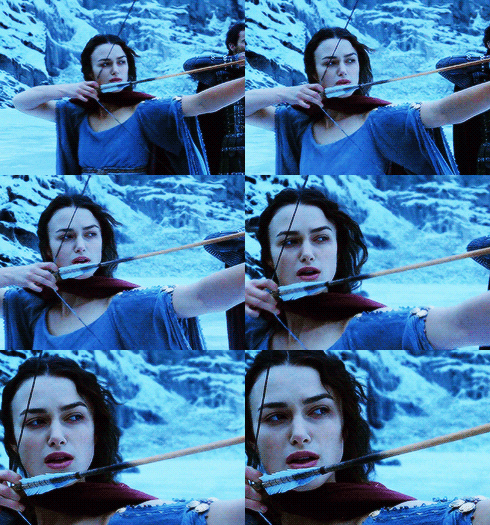
A surprising factor of this movie was the agency given to Guinevere. Keira Knightley does a great job at playing the damsel-not-in-distress as she calls Arthur on his bullshit (see: "animals live, don't you want to live free") and holds her own...once she's rescued from prison. She chooses to stand on the sketchy frozen body of water and fight with the group of round-table knights. Guinevere also chooses to sleep with Arthur rather than the other way around; the way it is shot shows that she is in control of the situation, as she makes the sexual advances and seduces Arthur. 

I question the accuracy of a prisoner not only being able to freely speak her mind to a knight, but to also go on to marry a king. I wonder, too, about the legitimacy of a woman choosing to fight in a battle with absolutely no contest. I'm sure that women had more agency than what I was taught to believe, but something tells me that may be a bit exaggerated for the purposes of telling the story...I don't know, maybe I'm overthinking but it just doesn't click for me. All that said, I love seeing a powerful woman in full control of what she does in the battlefield and in the bedroom. You go Guinevere! 

she looks super badass tho